Human in the loop content: the brief is the job
Many teams run the loop backwards: AI writes the brief, a person writes the draft, AI edits. The order that works is the opposite. What goes in a brief the model cannot write, what the model is good at once it has one, and the two checks that catch the draft that reads like everyone else's.
How should AI be used for SEO content?
Humans write the brief. The model writes the draft. Humans edit. That order, and only that order.
The version many teams settle into runs the other way: the brief is created with AI, a person writes the draft, and AI does the proofreading and editing before it is published. That is backwards. The better results come from people doing the brief, AI writing the draft, and people doing the edit.
The reason is simple once said. The brief is where the knowledge lives: what the reader needs, what the business knows that competitors do not, which claims are true. A model cannot supply any of that, and if it writes the brief it writes a generic one and every draft that follows is generic. The draft, by contrast, is mostly labour, and the model is good at labour.
What goes in the brief
One test decides whether a page deserves to exist: if anyone can create it with a prompt, there is no reason for a search engine or an AI assistant to crawl, index and rank it, because they could run that prompt themselves.
The mindset for the brief: write it for a new author who is very smart, knows nothing about your business, and will make things up unless you give them very explicit instructions, and then have someone double-check the result.
Data and quotes are the two things the model cannot invent without lying, so they are the two things that make a page different from the ten pages already ranking. A brief that carries them produces a draft with something in it. A brief that says "write 1,500 words about X" produces the eleventh page.
The rest of the brief is what you would tell a good freelance writer on their first day:
- Who reads it and what they already know. The reader of this library owns a KPI and not the site; the reader of a plumber's page owns a leak.
- What the reader should be able to do after reading. One thing.
- The data. Your Search Console numbers, your tracker, your audit, a customer's actual words. Pulled through the MCP if you have it connected, pasted if not.
- The quotes, verbatim, with who said them and where.
- What not to say. The claims you cannot back, the competitors you do not name, the product features that do not exist yet.
AI works well when you have expertise to feed into it. The expertise is relayed in the brief. If you do not have it, the model does not either.
What the model is good at
Once the brief exists, the model earns its place. What it removes is the pre-work, which is where a lot of time and energy goes. The pre-work is pulling the data into one place, outlining against the brief, writing the first draft of every section, drafting the FAQ from the questions people ask, formatting. An afternoon becomes a minute, and the afternoon was never where the value was.
What it does to the team is turn makers into editors. The role did not disappear; it moved to the two ends of the loop where the judgement is.
The edit: two checks that catch the generic draft
The model's draft has a signature. It hedges, it lists in threes, it opens paragraphs with a throat-clearing phrase, it reaches for the same dozen adjectives every other draft reaches for. A reader may not name what is wrong with it, but they stop reading.
Two checks, in order.
First, the fact pass. Every number traces to a source in the brief. Every quote matches its transcript. Every product claim is true today, not last quarter. This is the check the model cannot run on itself, because it does not know which of its sentences it invented. A useful question to write into the review: if a reader trusted every claim and opened the product right now, where would reality not match?
Second, the slop pass. A list of the phrases and structures that mark a machine draft, applied to the text: filler openers, false contrasts, the rhetorical questions the draft asks itself. You can also have the assistant compute a few measurements against a set of your own human-written pages: perplexity, compression ratio, and Jaccard and cosine similarity between texts. A draft that scores far from the human set on any of them needs another pass.
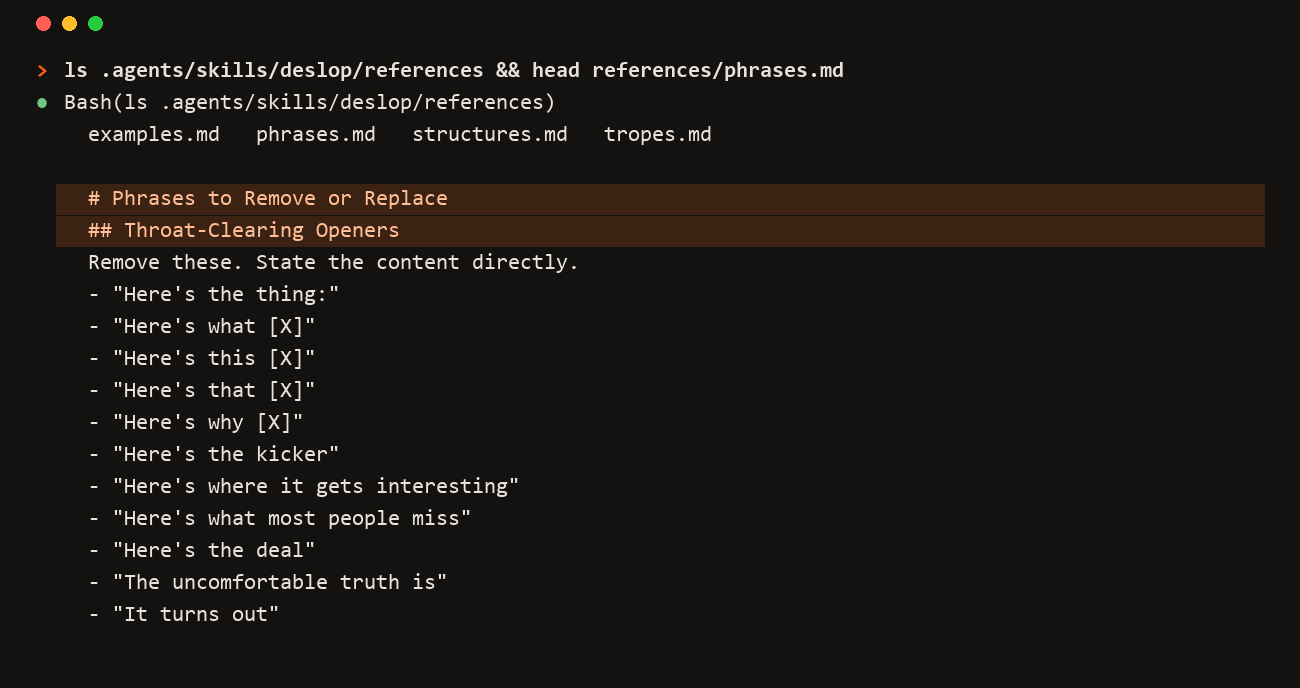
A cheaper version of the second pass works before you read a word: after working on a draft for a while, ask the model what feedback it expects you to give on it.
The loop matters for being cited at all. If an AI can write your blog post, it already has that knowledge, so it has no reason to cite your version. Run both passes and what remains is a draft that a person briefed, a model wrote, and a person checked. That is the loop. Editors are still needed; the editors worth hiring now are the ones who use AI constantly.
Run this with the SEO Scaler MCP
Connect the SEO Scaler MCP. This prompt makes the assistant assemble the brief's data half and then refuse to draft until the human half exists.
Using the SEO Scaler MCP on project [name], prepare a brief for a page
about [topic]:

1. Pull Search Console performance for the last 3 months by query,
   filtered to queries containing [topic word]. Show me the top 15
   with clicks, impressions and position, and the URL that ranks.

2. Call get_keyword_metrics for the 15 plus five variants you think
   are missing. Give me volume, difficulty and intent.

3. Call get_serp_results for the top 3 terms and list the ranking
   URLs with their titles. Tell me in one line what each page has
   that the others do not.

4. Stop. Ask me for: who the reader is, the one thing they should be
   able to do afterwards, two to four verbatim quotes with sources,
   and anything the page must not claim. Do not draft until I answer.

5. After I answer, write the brief as a one-page document with those
   answers at the top and the data underneath. Then, and only then,
   draft the page from the brief.
Step 4 is the human in the loop, made mandatory. An assistant that skips it produces the backwards version described above, and it will skip it unless told not to.
The brief is where you are
A page is worth reading because of what the writer knew. The model knows nothing about your reader, your data or your customers until you put it in the brief, and everything it drafts after that is only as good as what you put there. Write the brief, let it draft, edit it hard. Skills, memory and the trace is how to make the second and third steps repeatable.
AI content FAQ
How do I use AI for SEO content without producing generic pages?
Write the brief yourself: the reader, the one thing they should do, your own data, verbatim quotes, and what not to claim. Let the model draft from that. Then run a fact pass against the brief and a pass for machine-writing phrases before anything ships. Every skipped step shows in the result.
Should AI write the brief or the draft?
The draft. A brief written by a model contains only what the model already knew, which is what every competing page already says. A brief written by a person carries the data and quotes that make the page different. The draft is labour; the brief is knowledge.
What is human in the loop content?
A workflow where a person owns the two ends, briefing and editing, and a model does the middle. It is the opposite of the common pattern where the model briefs and edits while a person writes, which produces polished pages with nothing in them.
How do I check an AI draft?
Two passes. Fact: every number, quote and product claim traces to the brief or the source. Slop: remove the phrases and structures that mark machine writing, such as filler openers, false contrasts and stacked rhetorical questions. Keep both checks as written lists so every draft gets the same review.
Does SEO Scaler write content?
SEO Scaler pulls the data half of a brief: Search Console performance, keyword metrics, SERP results, competitors, audit findings. The assistant writes from the brief you complete, and a person still owns the brief and the edit.
Run this strategy in SEO Scaler
Run the MCP prompt in this guide with SEO Scaler. SEO Scaler is free to try, and asks before every paid call.